
08/06/26
The Use of Non-Conventional Endoprostheses in Complex Orthopedic Reconstruction
The Use of Non-Conventional Endoprostheses in Complex Orthopedic Reconstruction: Surgical Planning, Fixation, and Clinical Outcomes
Bone reconstruction following tumor resections, extensive metastatic lesions, segmental bone defects, or complex structural losses represents one of the most challenging scenarios in contemporary orthopedics. Treatment must balance local disease control, early functional restoration, mechanical stability, implant durability, soft tissue preservation, and the reduction of complications such as infection, dislocation, aseptic loosening, mechanical failure, and the need for revision surgery.
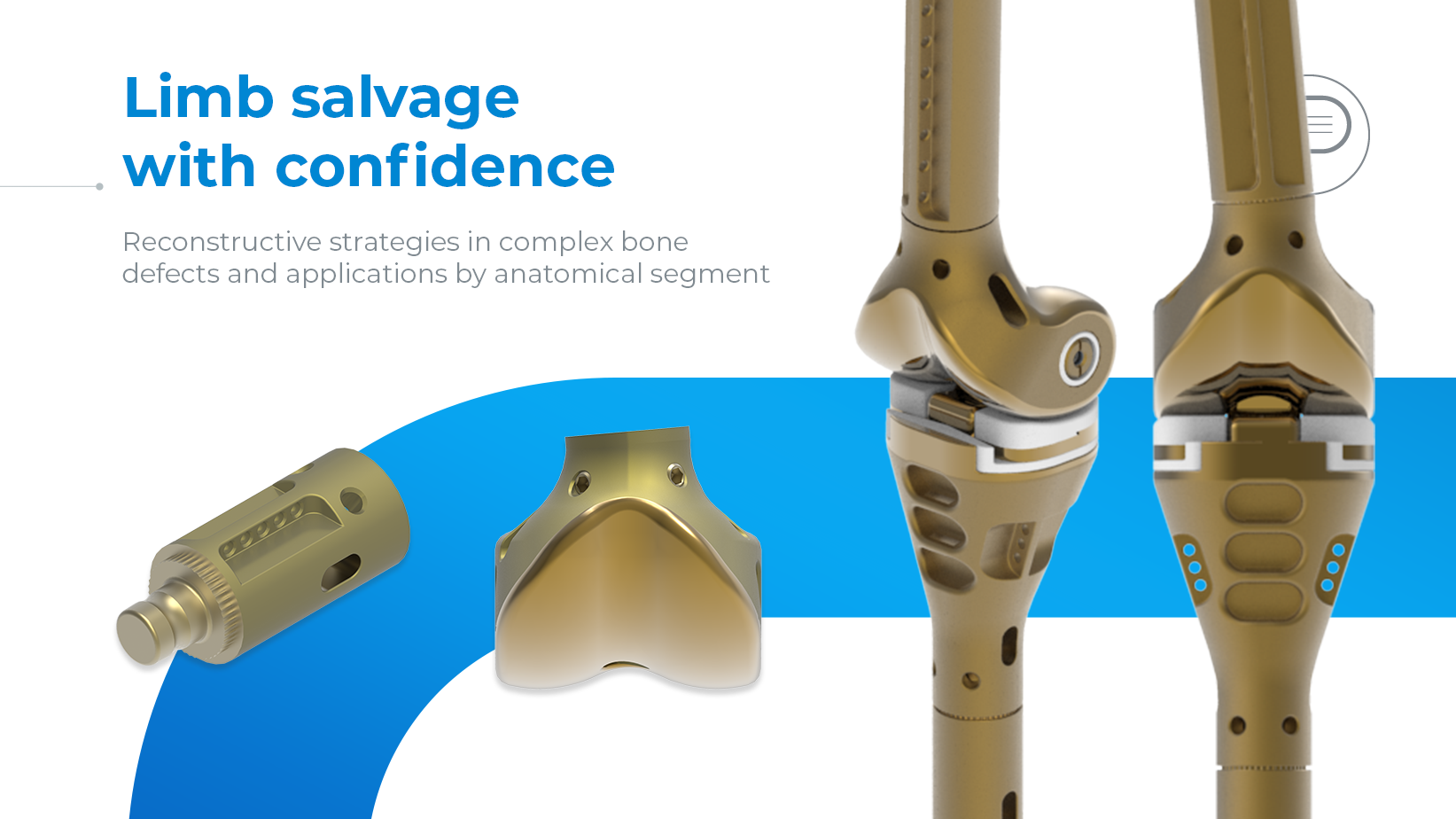
In this context, tumor endoprostheses—also known as megaprostheses or non-conventional endoprostheses—have become important alternatives for limb preservation and functional recovery, particularly when conventional osteosynthesis techniques, structural grafts, or primary arthroplasties do not provide sufficient support. The literature demonstrates that several variables directly influence clinical outcomes. This article analyzes key aspects based on scientific studies and systematic reviews, relating the main concepts to the way Baumer technically develops orthopedic solutions focused on clinical performance.
Contact Orthopedics
📧 ortopedia.comercial@baumer.com.br
📱 WhatsApp: +55 (11) 97281-4198 – Click here to contact us
📞 Phone: +55 (11) 3670-0015
For physicians interested in discussing solutions for complex orthopedic reconstruction, Baumer’s technical team is available through the contact channels listed on the official website.
The evolution of non-conventional endoprostheses is directly linked to advances in limb-salvage strategies for patients with primary bone tumors, soft tissue tumors with bone involvement, bone metastases, and major structural bone loss. Endoprosthetic reconstructions have assumed a central role not only in orthopedic oncology but also in complex revision procedures, reconstructive failures, and situations requiring the replacement of extensive bone segments.
This approach highlights that surgical decision-making should not be limited to the anatomical replacement of the resected segment. Instead, the reconstructive system should be viewed as an interface between the remaining bone, mechanical demands, soft tissue envelope, joint stability, and other relevant factors.
Reconstruction with megaprostheses requires careful planning because bone resection or structural loss often compromises muscle insertions, joint stability, periarticular tissues, and the ability to properly transmit loads. In these cases, the surgeon must evaluate the extent of bone loss, the quality of the remaining bone, the need for joint reconstruction, the degree of soft tissue involvement, and the possibility of achieving primary stability.
System stability depends on multiple factors rather than a single technical component. Surgical approach, muscle reconstruction, soft tissue tension, implant geometry, alignment, reconstructed segment length, and fixation method are variables that must be considered collectively.
This point is particularly important because it directs the discussion toward the integration of surgical technique and implant design. In joints subjected to extensive resections, soft tissue management may be critical for reducing instability, improving motor control, and facilitating rehabilitation. Likewise, in diaphyseal or metaphyseal reconstructions, load distribution, implant alignment, and the interface with the remaining bone directly influence the risk of loosening, periprosthetic fracture, or mechanical failure.
From an implant engineering perspective, this discussion aligns with the principles applied to the development of modular orthopedic systems. In technically developing solutions for complex reconstructions, Baumer considers modularity not merely as an assembly feature but as a tool for anatomical adaptation, biomechanical restoration, and intraoperative flexibility.
In scenarios involving extensive bone resection, the ability to select components compatible with different levels of bone loss allows the surgeon to pursue a better balance between primary stability, alignment, limb length restoration, joint reconstruction, and soft tissue coverage. Therefore, the concepts of modularity, fixation, segmental reconstruction, joint stability, and tumor bone replacement are fundamental to understanding how Baumer approaches this subject in terms of design, manufacturing, and technical support.
For cases requiring a technical evaluation of systems intended for orthopedic reconstruction, contact Baumer through the phone numbers available on the website and speak with our specialized team.
Another important consideration is the choice between cemented and cementless non-conventional endoprostheses. Cemented fixation may provide immediate stability, especially in patients with poor bone quality, metastatic disease, or a need for early mobilization. Conversely, cementless systems depend on primary stability and the potential for bone integration and may be considered when adequate local conditions and good bone contact are present, among other factors.
The choice between these strategies should be individualized, taking into account age, diagnosis, bone quality, extent of resection, associated oncological treatment, infection risk, functional demand, and the possibility of future revision procedures.
In oncology patients or individuals undergoing major reconstructions, the decision should not be based solely on technical preference but rather on an integrated assessment of biological condition, mechanical requirements, and therapeutic goals.
From a technical standpoint, systems designed for extensive reconstructions must withstand high cyclic loads while maintaining stability in a biological environment that is often unfavorable. In patients undergoing tumor resections, chemotherapy, radiotherapy, or multiple surgical procedures, vascular alterations, impaired healing, loss of muscular coverage, and an increased risk of infection may be present.
For this reason, concepts such as implant survivorship, aseptic loosening, mechanical failure, periprosthetic infection, osseointegration, reconstruction of large bone defects, and functional outcomes should be central to both clinical assessment and technological development.
The literature also demonstrates that functional outcomes must be interpreted with caution. In patients undergoing complex reconstructions, particularly in an oncological setting, success cannot be measured by a single factor alone. The ability to sit, ambulate with support, manage pain, preserve independence, and maintain quality of life may represent significant clinical benefits.
Therefore, functional scoring systems, complication rates, revision requirements, and implant survivorship should be evaluated alongside prognosis, disease extent, functional expectations, and therapeutic objectives. The choice of a reconstructive system should consider not only its mechanical performance but also its real impact on patient rehabilitation.
In this context, Baumer can contribute technically by providing surgeons with solutions aligned with the principles discussed in the scientific literature: reconstructive planning, component compatibility, dimensional precision, mechanical reliability, and specialized technical support.
Learn More About Baumer Orthopedic Solutions
To learn more about Baumer solutions applied to orthopedic reconstruction and discuss technical possibilities with our team, please use the contact information available on the official website.
Contact Orthopedics
📧 ortopedia.comercial@baumer.com.br
📱 WhatsApp: +55 (11) 97281-4198 – Click here to contact us
📞 Phone: +55 (11) 3670-0015
In summary, reconstructions using tumor endoprostheses and megaprostheses represent a well-established alternative for cases involving extensive bone loss, yet they remain associated with significant challenges. System stability depends on factors related to the patient, the disease, surgical technique, bone quality, soft tissue management, previous treatments, and other variables.
The choice between fixation methods continues to depend on the clinical context, requiring an individualized assessment that balances immediate stability, integration potential, infection risk, revision possibilities, and the need for early rehabilitation.
For physicians, understanding these factors is essential for selecting the most appropriate reconstructive strategy. For the industry, these factors guide the development of increasingly adaptable, durable, and clinically relevant systems capable of meeting the real demands of complex orthopedic surgery.
In this regard, Baumer positions itself as a company that follows the scientific evolution of the field and translates these concepts into orthopedic solutions developed with technical rigor, a functional focus, and a commitment to specialized surgical practice.
If It's Baumer, You Can Trust It!